
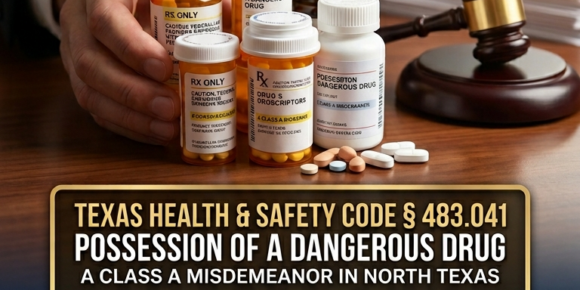
Possession of Dangerous Drug Attorney
A common misconception in North Texas is that you cannot be convicted of drug possession if the pills in your car belong to someone else—especially if that person is willing to testify that the medication is theirs.
At Beltz Law Group, we see this scenario frequently: a driver is pulled over, and a search reveals a prescription bottle in the console. Even if the bottle has a friend’s name on it and that friend confirms you were just doing them a favor, you can still face serious criminal charges.
In Texas, the legal definition of “possession” is much stricter than most people realize.
The “Ultimate User” Trap
Under Texas Health and Safety Code § 481.115(a), possessing a controlled substance or dangerous drug is illegal unless you obtained it directly from a practitioner via a valid prescription in your name.
Texas law does provide a narrow exception for an “ultimate user.” An ultimate user is someone who lawfully possesses a drug for:
-
Their own use.
-
The use of a member of their household.
-
An animal owned by them or a household member.
The Danger: This exception does not extend to friends, neighbors, or even family members who do not live in your home. If you are caught with your girlfriend’s Xanax or your brother’s Adderall and you don’t live together, you are technically in unlawful possession of a controlled substance.
Why Owner Testimony Often Fails

Attorney For Criminal Case North Texas
Many defendants believe that if the actual owner of the medication comes to court and says, “I left those in the car by accident,” the case will be dismissed. However, Texas courts, such as in Hennessy v. State, have expressed significant skepticism toward these “safekeeping” claims.
-
Jury Discretion: Juries are legally allowed to disbelieve any testimony. They often view “it belongs to my friend” as a convenient excuse rather than a valid legal defense.
-
The Burden of Proof: In most criminal matters, the state must prove every element. However, regarding prescriptions, the burden is on the defendant to prove they fall under a legal exception (Dowden v. State). If you cannot prove you are a household member or the legal patient, the law assumes the possession is unlawful.
The Stakes: From Misdemeanors to Felonies
While some “dangerous drugs” result in Class A Misdemeanors, many prescription medications fall into Penalty Groups that trigger felony charges based on the aggregate weight of the pills (including fillers).
| Amount | Charge Level |
| Less than 1 gram | State Jail Felony |
| 1 to 3.99 grams | 3rd Degree Felony |
| 4 to 199 grams | 2nd Degree Felony |
| Over 400 grams | Enhanced 1st Degree (Up to Life in Prison) |
Important Note: The “Medical Emergency” defense (Good Samaritan law) in Texas is extremely limited. It generally only applies to low-level possession during an active overdose report and does not protect you if you are simply driving with someone else’s medication.
Protect Your Future

Criminal Defense Lawyer North Texas
If you have been arrested for possession in Dallas, Fort Worth, or the surrounding North Texas areas, do not rely on the “owner” of the drugs to clear your name. The prosecution will use the strict language of the Health and Safety Code to pursue a conviction regardless of who the pills were “intended” for.
At Beltz Law Group, we specialize in deconstructing the state’s case. From challenging the legality of the traffic stop to proving “household member” status, we fight to keep a momentary lapse in judgment from becoming a permanent felony record.
Don’t leave your freedom to chance.
Call Beltz Law Group today at 214-321-4105 or visit www.beltzlaw.com for a free consultation.